Eldon Grove Academy
English
Our Curriculum Drivers
We want every child to have every opportunity to experience success in each English learning episode.
All children are given the opportunity to study English to develop their abilities to listen, speak, read and write for a wide range of purposes, so using language to learn and communicate ideas, views and feelings.
Children access an engaging, exciting and innovative English curriculum which enables and empowers their written and oral communication and creativity. Children are presented with opportunity to become articulate writers and speakers, through the use of purposeful language and vocabulary.
By developing every child’s ability to reflect on their own and others’ contributions and the language used, it allows them a greater understanding of the world around them, equipping them with the skills to become lifelong learners.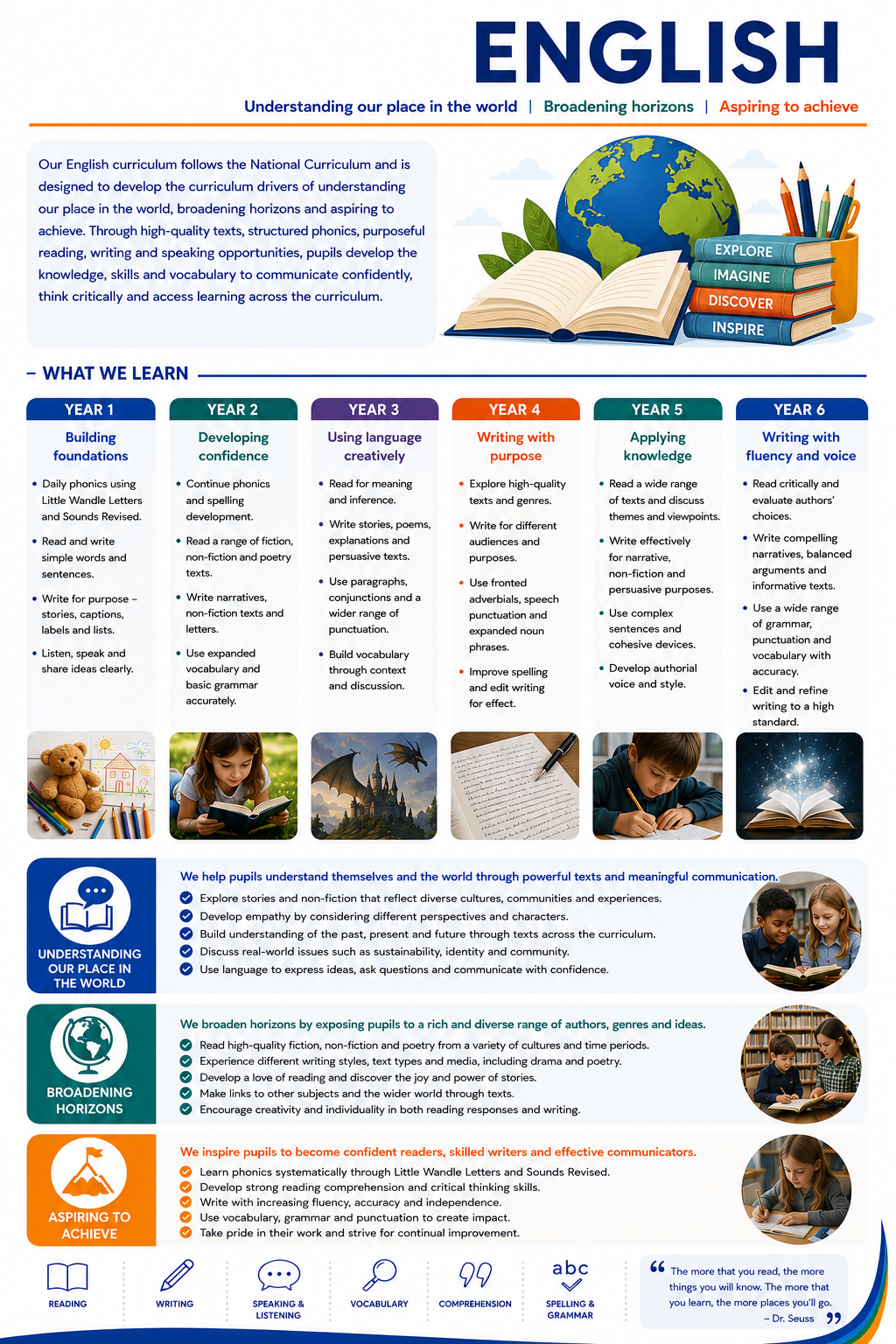
EGA's English Aims
Our aims of teaching English at Eldon Grove Academy are:
- to enable children to read and write with confidence, fluency and understanding, using a range of independent strategies to self-monitor and correct.
- to develop children’s love of reading;
- to grow confident, independent readers through an appropriate focus on word-reading and comprehension skills;
- to encourage children to become eager and reflective readers through exposure to a wide range of engaging and challenging texts;
- to help children enjoy writing and recognise its value
- to enable children to write with accuracy and meaning in narrative and non-fiction, understanding audience;
- to increase children’s capacity to use planning, drafting and editing to improve their work;
- to embed English skills so that children can use them in other curriculum areas;
- to enable children to speak clearly and audibly in ways which take account of their listeners;
- to encourage children to listen with concentration in order to be able to identify and summarise the main points of what they have heard;
- to enable children to adapt their speech and language to a wide range of circumstances and demands;
- to develop children’s abilities to reflect on their own and others’ contributions and the language used, in multiple contexts;
- to increase children’s confidence when evaluating their own and others’ contributions through a range of drama activities.
Reading at Eldon Grove Academy
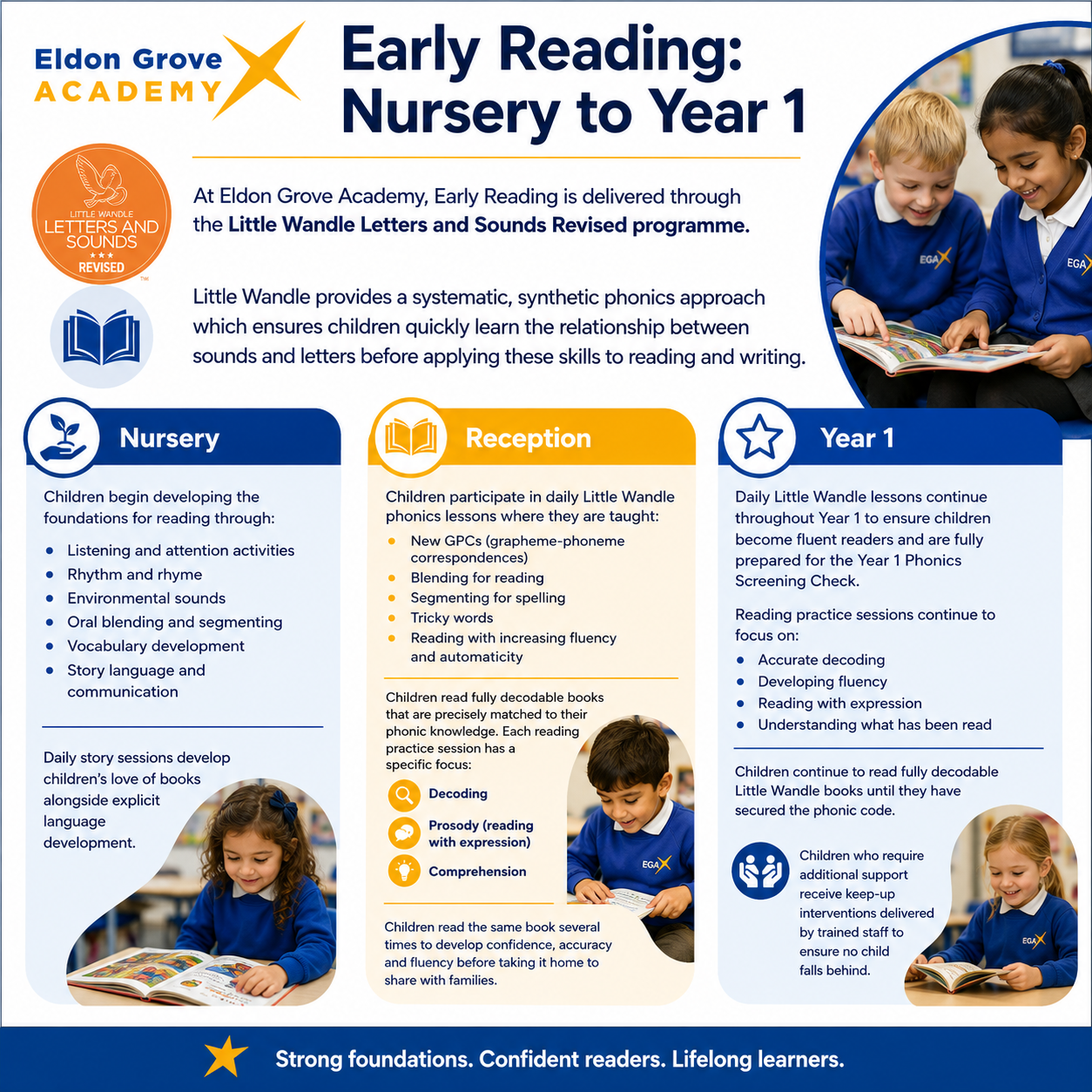
At Eldon Grove Academy, we believe that reading is the gateway to all learning. We are committed to developing confident, fluent and enthusiastic readers who read for both purpose and pleasure. Reading is prioritised across the curriculum and every child engages in high-quality reading every day.
Our reading curriculum is carefully sequenced from Nursery to Year 6, ensuring children develop strong word recognition, reading fluency, vocabulary, comprehension and a genuine love of reading.
Reading is taught through three complementary elements:
- Early Reading and Phonics
- Whole Class Reading
- Reading for Pleasure
Alongside this, reading opportunities are embedded across the wider curriculum to continually develop children's background knowledge, language and vocabulary.
Reading in Year 1
Alongside Little Wandle reading practice sessions, Year 1 children participate in five whole-class reading sessions each week designed to broaden comprehension, vocabulary and background knowledge.
Each weekly text is carefully selected and explored through a structured sequence.
Day 1 – Building Background Knowledge
- Activate prior knowledge
- Introduce key vocabulary
- Remove barriers to understanding
- Explore context and author
Day 2 – Developing Fluency
- Teacher modelling
- Echo reading
- Choral reading
- Partner reading
- Developing expression and prosody
Day 3 – Reading Closely
Children interrogate sections of the text by:
- Retrieving information
- Exploring vocabulary
- Making observations
- Discussing author's choices
Day 4 – Developing Understanding
Children answer increasingly challenging questions which develop:
- Vocabulary
- Retrieval
- Inference
- Prediction
- Authorial intent
Day 5 – Applying Understanding
Reading in Year 2
Children who have completed Little Wandle move into our Phonics to Fluency programme.
These sessions take place three times each week and focus on repeated reading to increase automatic word recognition and reading fluency. The aim is to reduce cognitive load, allowing children to focus increasingly on comprehension.
Children also participate in five whole-class reading sessions each week using high-quality fiction, poetry and non-fiction linked to the wider curriculum.
Reading lessons continue to develop:
- Vocabulary
- Retrieval
- Inference
- Prediction
- Summarising
- Author's language choices
- Comparison between texts
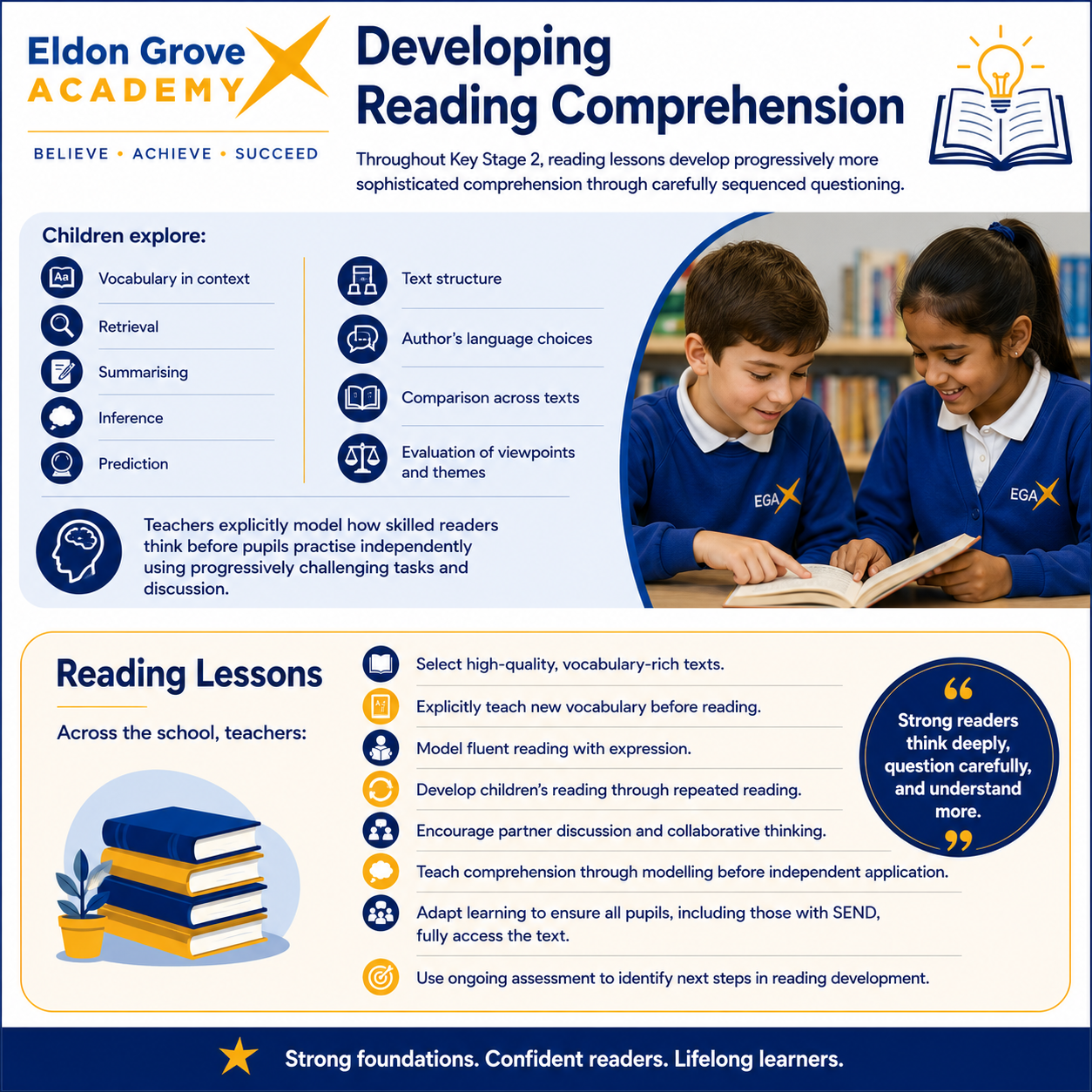
Reading in Key Stage 2
All pupils participate in five dedicated reading lessons each week.
Reading lessons are separate from, but closely linked to, English writing lessons and are based around carefully chosen high-quality class texts.
Each week's learning centres on a selected extract, enabling pupils to read deeply rather than quickly.
Lessons follow a consistent structure to develop both fluency and comprehension.
Each lesson includes:
- Activating background knowledge
- Explicit vocabulary instruction
- Teacher modelling of fluent reading
- Echo reading
- Choral reading
- Partner reading
- Independent reading
- Explicit modelling of comprehension using teacher "think alouds"
- Guided practice
- Independent application
This approach ensures pupils repeatedly hear expert reading before practising themselves, supporting both accuracy and prosody.
Writing at EGA
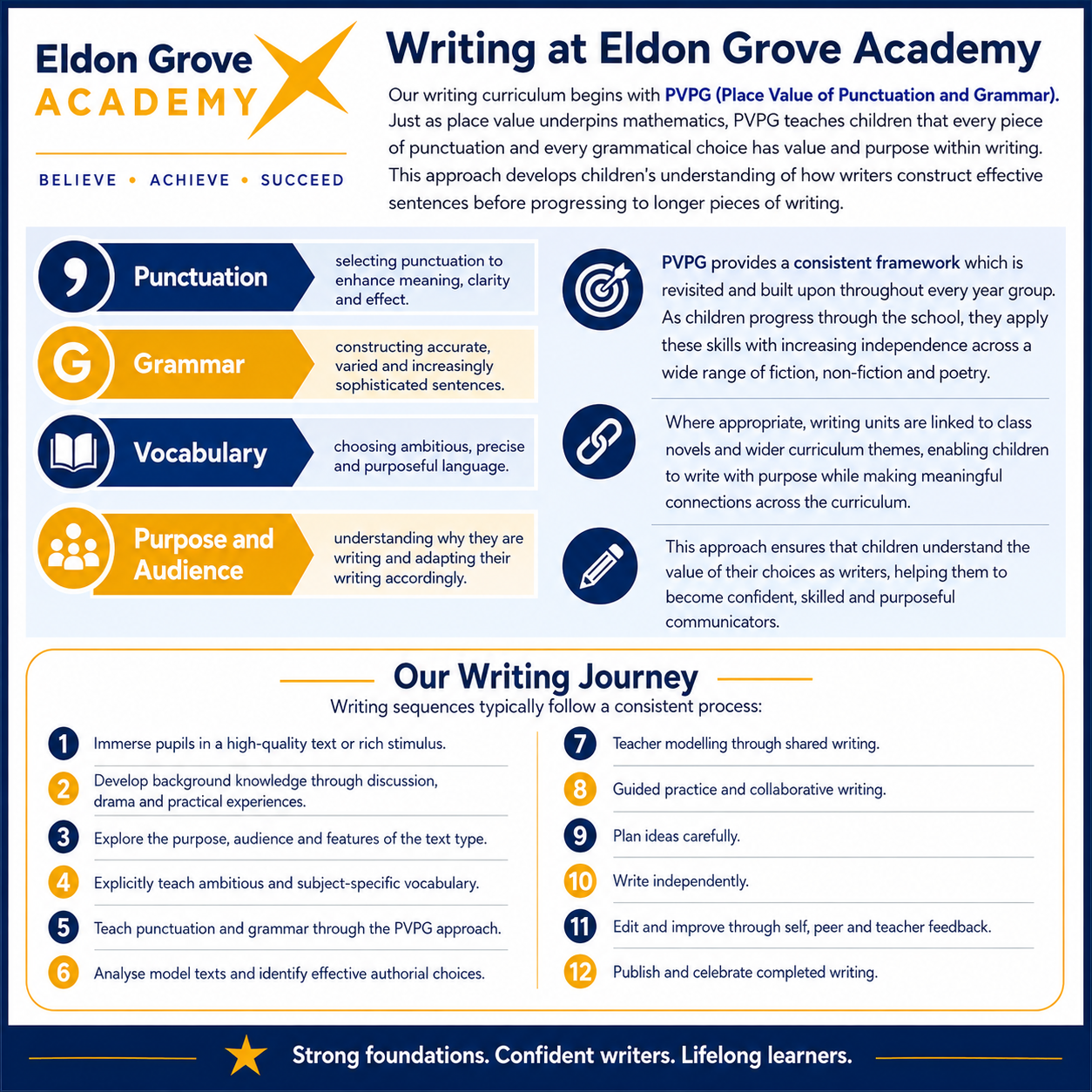
Writing lessons take place every day and are rooted in high-quality texts, rich vocabulary and meaningful curriculum experiences. Our writing curriculum is carefully sequenced from the Early Years to Year 6, ensuring children develop the knowledge, skills and confidence to write effectively for a range of purposes and audiences.
Spelling at EGA
Spelling sessions take place at least four times per week during our teaching of English. Each lesson is designated to a specific area of spelling. The structure of the spelling sessions are as follows:
Lesson 1: Introducing the rule/pattern for the coming week. This first session has no cognitive overload. The rule/pattern is introduced through a stimulus (picture, artefact, guess the rule, same/different etc). Children are not to write the rule, but instead a sticker of the rule will be stuck into their spelling book. Within this session, children should use their prior knowledge of words to identify the rule, with planned links to other topics/units around the curriculum. Each week, the spelling rule will be sent to parents on Class Dojo and be a part of that week’s homework offer.
Lesson 2: This session is designed to investigate and explore the words and rule/pattern/convention). Here, children will be identifying if the rule involves prefixes, suffixes, silent letters/sounds, homophones, plurals etc. Furthermore, children will be exploring the morphology of the words, the etymology of the words, creating pseudo words, creating “silly sentences”, looking at how the spelling changes the meaning of the word/sentences (especially in homophones) and looking at alternative sounds/pronunciation.
Lesson 3: Tackling the tricky part: This session takes out the cognitive overload for children. Within each word/rule/pattern/convention, the children are identifying the ‘tricky’ part of the spelling. Teachers are to consider how to ‘hang the knowledge on to the child’ through the use of images, acronyms, analogies, songs etc. In KS2, these can be incorporated into the use of handwriting to achieve that muscle memory when handwriting the ‘tricky’ parts. Closed procedure activities are encouraged at this stage e.g. “Feb___ary”.
Lesson 4: The final spelling session of the week focuses on the application of the rule/pattern. Through differentiated activities, children could fill in the blanks for sentence (with or without a word mat), write a paragraph incorporating the word(s) and looking at the ‘bigger picture’ – these words added to the English working wall to ensure application across the curriculum. These spellings should then form part of any self/peer assessment in writing and would make up a large part of teacher spelling feedback for that week.
Punctuation and Grammar at EGA
Punctuation and Grammar is built into the daily teaching of English. During this session, teachers plan activities to develop children’s knowledge and understanding of specific terminology, its purpose and application within written English. Strong examples are shown – when possible – from places within the class text. Targeted areas of Punctuation and Grammar, along with sentence and vocabulary-level lessons are taught within the Writing Cycle. In addition, there is a separate sentence-level lesson in the Writing Cycle. This is carefully planned so that the focus fits with the text type being taught and therefore, the children have ample opportunity to apply relevant skills to written work. Taught elements of Punctuation and Grammar are added to the English Working Wall, to ensure high expectations and exposure.